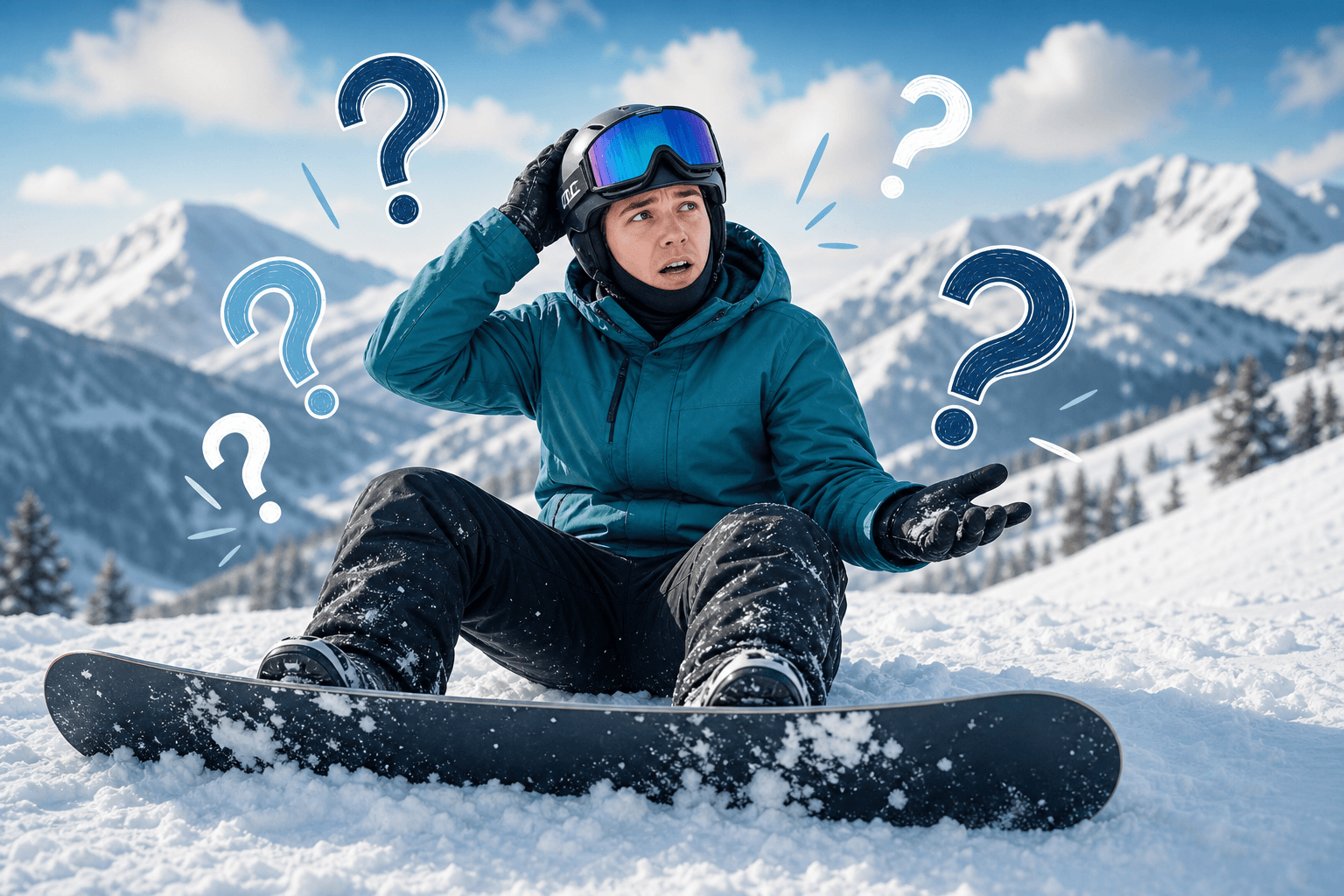
Most people walk up to their first day a little nervous. Good — that means you care. Here's exactly what the day looks like, so the only surprise left is how much you enjoy it.
You're going to fall, and that's fine
The first thing I tell everyone: falling isn't the failure, it's the lesson. A snowboard has two edges — toe and heel — and learning to ride is mostly learning to trust one edge at a time. You'll catch the wrong one a few times early on. Everyone does. We start on gentle, forgiving ground in the free beginner zone, so a fall is a soft sit-down, not a crash. Within an hour they thin out on their own.
One small thing helps more than people expect: when you feel yourself going, relax instead of bracing. Stiff arms catch the snow hard. Loose ones don't.
What to wear — and what not to buy yet
Don't spend a franc on gear for day one. Rent the board and boots; I'll point you to the right shop. What you bring from home matters more:
- Waterproof jacket and trousers. You'll be sitting in snow. Wet jeans end a day fast.
- Proper gloves, not woolly mittens. Your hands are down in the snow a lot at first.
- Goggles and sunscreen. The light off the snow is brutal, even when it's grey.
- Thin layers. You'll warm up the moment you start moving.
One extra I always recommend: knee pads or a padded short (the kind with tailbone protection). Skate ones work perfectly. They're not required, but they cushion the falls and — more than anything — make the fear leave sooner: once you know the ground won't hurt, you loosen up a lot faster.
That's it. No helmet camera, no expensive jacket, no board of your own. Ride a few times first, then we'll talk about what's actually worth buying.
The first hour is all about one edge
We don't point you downhill and hope. The first hour is slow on purpose. You'll learn how to strap in, how to stand up, and how to slide on your heel edge with the board across the slope — what's called a side-slip. It feels like nothing, but it's the whole foundation: control your heel edge and you control your speed, and once you control your speed, the fear goes.
When the heel edge feels safe, we add the toe edge, then link them. That linking is where snowboarding actually begins.
The moment it clicks
There's a point — usually somewhere in the second hour — where you stop thinking about your feet and just ride a few metres clean. People laugh out loud when it happens. That's the moment I'm coaching toward the whole time.
It's also why I film bits on my phone as we go. You can't see your own progress from the inside, but you will on the video that evening — the toe-edge turn you were sure looked terrible usually looks far better than it felt.
How long until I'm actually riding?
Honest answer: most people can ride gentle blue runs, linking turns, after two or three good sessions. Day one isn't about conquering the mountain — it's about leaving with the basics solid and the nerves gone. A focused First Day (two hours, just us) is built exactly for that. If you only want to fix one thing or get your confidence back, an hour is enough.
A few things first-timers always ask
- Do I need a lift pass? Not on day one. We stay in the free beginner zone, so there's nothing to buy to get started.
- Am I too old, or too unfit? Almost certainly not. I've taught plenty of adults who were sure they'd be the exception. They weren't.
- What if it's snowing or grey? We still ride. Fresh snow is softer to fall on, and you'll be warm once you're moving.
Come ride
Day one is the hardest to book and the easiest to enjoy. Pick a date, meet me at the COLORS door at Flumserberg, and we'll get you riding. If anything's unclear before then, just call me: +41 76 638 18 70.